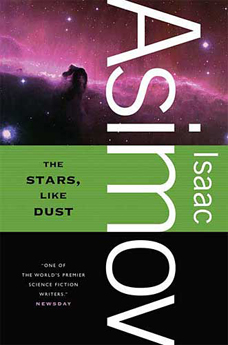
I’m about to commit what some might call tantamount to geek treason. I’m about to trash an Isaac Asimov book.
First, though, I’m going to make a somewhat shocking confession: Prior to now, I have never actually read an Isaac Asimov novel.
Okay, I’ll wait while you all digest that.
…
Yes, I did just admit that I was an Asimov virgin until now. Well, not completely. You can’t be a geek, especially a TNG geek, without knowing Asimov. After all, our favorite android possessed a “Soong-type positronic brain.” Positronic brains came straight from the brain of one Mr. Isaac Asimov, father of the three laws of robotics:
- A robot may not injure a human being or, through inaction, allow a human being to come to harm.
- A robot must obey any orders given to it by human beings, except where such orders would conflict with the First Law.
- A robot must protect its own existence as long as such protection does not conflict with the First or Second Law.
This is all moot, however, since none of this relates to the Asimov book I did read, The Stars, Like Dust. Apparently, this is a recent re-release. It was positioned on the New Arrivals shelf at the library, all sparkly new and, strangely enough, without a protective plastic cover. I quickly snatched it up, taking its presence as a sign that it was time I delved into something Asimovian.
I should have gone to find I, Robot instead. This was not at all what I was expecting—although, thinking back now, I’m not really sure what exactly I was expecting. What I found, though, was a story that was predictable, irritatingly misogynistic at several points, and the ending…oh the end quote was painfully nationalistic (although, I can’t say that I wouldn’t have been slightly America crazy if I was a Russian-born author who was now trying to make it as a resident of my birth country’s Cold War rival).
I know, I know. It was predictable because so many people have ripped Asimov’s style throughout the years. He is considered by many to be one of the early scions of science fiction storytelling. I wholeheartedly acknowledge and accept this as truth. He laid the foundation on which so many other sci-fi authors, directors, producers, screenwriters, etc. have built their own livelihoods. I respect Asimov for this fact and know that my favorite genre owes him a great debt.
That being said, I kind of view this first Asimov taste to my first viewing of Crouching Tiger, Hidden Dragon. This movie was heralded here in the States as being ground-breaking for its breathtaking CGI-enhanced martial arts work. I totally agree. However, I only saw this movie after I saw its successor at the time, House of Flying Daggers. This latter movie owes a HUGE debt to the former. In my eyes, however, the latter is the superior movie. It took the former as inspiration and then took that inspiration to a whole new level, even higher than the first.
I think that’s how I need to look at this particular Asimov story: the inspiration that has led so many others to greater, higher sci-fi climes.
The Stars, Like Dust is part of Asimov’s Empire series. I don’t think this fact in any way detracted from the story, as it stood on its own quite well. Also, the book was written in 1951, so the fact that he wrote a female character even half as composed as Artemisia oth Hinriad was in this novel is quite exceptional. For 1951.
Final score: 2.5/5.
I want to give this a perfect score. I want Asimov to be at the top of my list of favorite authors. This book, however, was not the book to place him there. I’m not giving up though. Next trip to the library, I’m going to delve a little deeper and see what else they have from Asimov’s impressive oeuvre. And if anyone out there has a recommendation for what I should look for, let me know!

