Warning: "continue" targeting switch is equivalent to "break". Did you mean to use "continue 2"? in /home/ih1v0f0zxragxwcy/public_html/blog09/wp-content/plugins/jetpack/_inc/lib/class.media-summary.php on line 77
Warning: "continue" targeting switch is equivalent to "break". Did you mean to use "continue 2"? in /home/ih1v0f0zxragxwcy/public_html/blog09/wp-content/plugins/jetpack/_inc/lib/class.media-summary.php on line 87
Notice: Trying to access array offset on value of type bool in /home/ih1v0f0zxragxwcy/public_html/blog09/wp-content/plugins/wc-gallery/includes/functions.php on line 675
Notice: Trying to access array offset on value of type bool in /home/ih1v0f0zxragxwcy/public_html/blog09/wp-content/plugins/wc-gallery/includes/functions.php on line 676
Notice: Trying to access array offset on value of type bool in /home/ih1v0f0zxragxwcy/public_html/blog09/wp-content/plugins/wc-gallery/includes/functions.php on line 677
Notice: Trying to access array offset on value of type bool in /home/ih1v0f0zxragxwcy/public_html/blog09/wp-content/plugins/wc-gallery/includes/functions.php on line 678 L o b a B l a n c a {dot} c o m | If there's nothing wrong with me, maybe there's something wrong with the universe. | Page 3
Notice: Trying to access array offset on value of type null in /home/ih1v0f0zxragxwcy/public_html/blog09/wp-content/plugins/jetpack/modules/theme-tools/site-logo/inc/functions.php on line 106
What? Two reviews in an hour? What is this madness?
It’s called quick reviews of lackluster graphic novels. #spoilerz
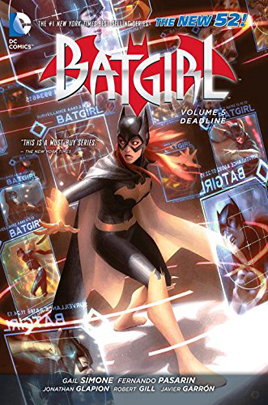
I finally got around to reading Volume 5 in the New 52 Batgirl reboot. Apparently, Deadline also is the last in this series before they rebooted the character again, moved her to a different location, changed her look, and changed her appeal to be more “youth-centered.” Translation: Batgirl ain’t for my old ass anymore.
Of course, this final Batgirl from the Gail Simone run wasn’t really for me either. I felt totally disconnected and confused by several of the stories in this collection. I’ve either forgotten key plot points from the previous four volumes or DC did to me what Marvel used to do all the time when I read X-Men comics (and that pissed me off just as much then as it did now with this collection).
I hate when comics become part of a story arc that runs across several titles. I mean, it’s okay every now and then, especially if you have a huge story that you know will require more than just one particular superhero and will deserve the wider audience (as I seemed appeased when they pulled this same thing in the third collection). However, I felt as though several themes in this collection were pieces from several different (and mediocre) puzzles that I simply didn’t care enough about to piece together. Also, it strikes me as frustratingly and offensively greedy of comics companies to demand that readers invest so much money into being able to get the whole story when all they might care about is one faction of the comics universe.
[Loba Translation: I don’t give a damn about Batman. Stop trying to make me give a damn.]
Final Verdict: Just as it was with my last Batwoman experience, I’m drawing the line at 5 with Batgirl. I won’t be following Babs and her roomie Alysia to Burnside.
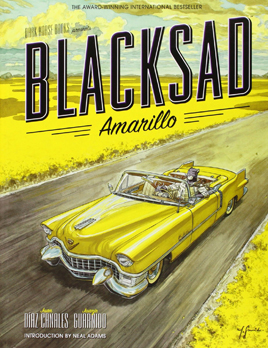
Back once more with another graphic novel from the Blacksad series by writer Juan Diaz Canales and artist Juanjo Guarnido. We haven’t had a new novel from this duo since their 2012 offering A Silent Hell. I gave that novel a bit of a lackluster review in comparison to my ebullient review of the first Blacksad collection.
I’m afraid that my review of this latest novel, Amarillo, is going to be even less enthusiastic. Guarnido is still producing stunning artwork for this series, but I feel as though perhaps Canales has reached his creative limit with this character’s story. I honestly found this tale trite and dull. Perhaps it’s because of my ongoing struggle to get into detective stories, but I ultimately think that it’s because there wasn’t really a story worth telling here. Perhaps it’s either time to let our private dick retire or take up residence with a different storyteller. However, I would like for Guarnido to continue being his artist. Guarnido’s art continues to be top shelf.
Final Verdict: I’ll hang on to this one for the artwork (another from my own collection!), but I seriously doubt whether I would give another novel from this series a go.
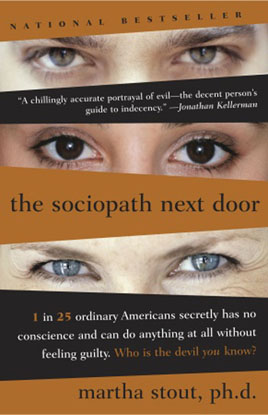
According to Dr. Martha Stout, clinical psychologist and author of The Sociopath Next Door, at least 25 percent of the American population comprises people who are utterly devoid of any conscience.
They’re called politicians.
I kid. Kind of. Not really. After reading this book, I’m pretty sure that the majority of our politicians and millionaire business bullies fall within this conscienceless percentile. I’m pretty sure at least half the candidates running for president right now fit the profile. Even beyond the national stage, I’ve unfortunately known a few sociopaths through the years. I just didn’t know at the time that that was what they were. If only I’d learned of this book sooner.
Here, now, rather than re-inventing the wheel as I have been apt to do before, is a satisfying summary of Stout’s treatise, from Publisher’s Weekly:
[Dr.] Stout says that as many as 4% of the population are conscienceless sociopaths who have no empathy or affectionate feelings for humans or animals. As Stout (The Myth of Sanity) explains, a sociopath is defined as someone who displays at least three of seven distinguishing characteristics, such as deceitfulness, impulsivity and a lack of remorse. Such people often have a superficial charm, which they exercise ruthlessly in order to get what they want. Stout argues that the development of sociopathy is due half to genetics and half to nongenetic influences that have not been clearly identified. The author offers three examples of such people, including Skip, the handsome, brilliant, superrich boy who enjoyed stabbing bullfrogs near his family’s summer home, and Doreen, who lied about her credentials to get work at a psychiatric institute, manipulated her colleagues and, most cruelly, a patient. Dramatic as these tales are, they are composites, and while Stout is a good writer and her exploration of sociopaths can be arresting, this book occasionally appeals to readers’ paranoia, as the book’s title and its guidelines for dealing with sociopaths indicate.
I can see why they would feel compelled to add the last sentence to their review. I mean, the book’s title is pretty inflammatory if you were prone to even a smidgen of paranoia. However, 25 percent? Those are pretty solid odds in favor of everyone at some point having a run-in with a person who fits the sociopath profile. Knowing the signs by reading a book like this? That could make all the difference to your protection. Again, I wish I’d encountered this book a long time ago. Could have saved me a whole heap of trouble.
Final Verdict: I’m definitely going to keep the book (that’s right, I’ve finally read one of my own books!), but I also know a couple of people I’m going to lend it to. I’m pretty sure they’ll appreciate the information.
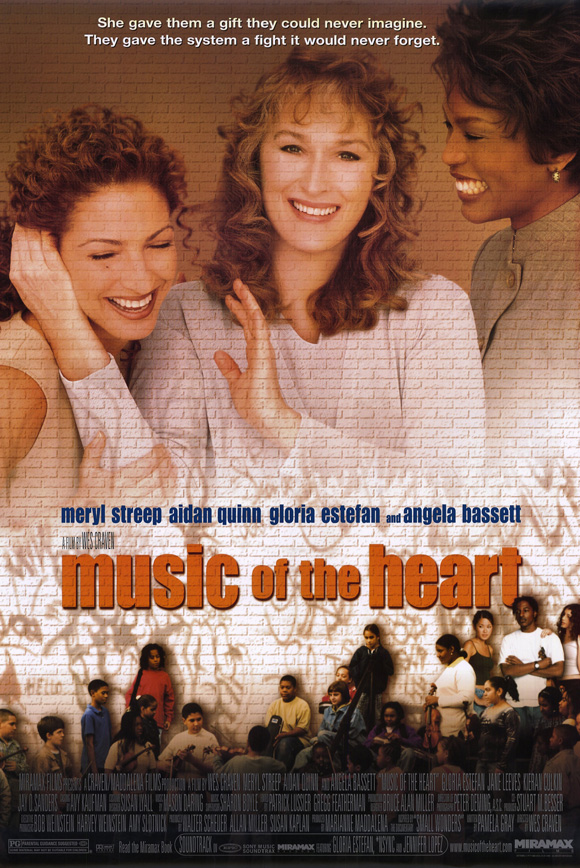
There’s a funny little throw-away line from Scream 3, spoken by the director of movie-within-a-movie Stab 3, where he complains that he had to direct a horror film before he could do the classic love story that he wanted to direct. Even though Music of the Heart comes before Scream 3 in Cravenous chronology (and it’s not really a “classic love story”), I mention the line because the exact opposite is how Wes Craven ended up getting this film to direct. He basically went to Dimension and the Weinsteins and said that he would direct the third Scream film only if they gave him the opportunity to direct something non-horror.
When you have a director of Craven’s horror-cred caliber saying he’ll come back to direct another movie for one of the biggest financial boons in your production company’s history? And one that he helped to make so financially feasible in the first place? You kind of do what he asks. And that is how the Master of Horror ended up not only finally getting his wish to direct outside of the genre that he had helped redefine but also getting to direct Meryl Streep to her twelfth Oscar nomination in this decidedly non-horror movie.
Quick bits of trivia first: The film is based on the true story of violinist and music teacher Roberta Guaspari and her efforts to teach violin lessons to inner-city children in Harlem. The movie came on the heels of, and was basically a remake of a 1995 documentary on Guaspari and her students, Small Wonders. Craven saw the original documentary and found it so poignant that he wanted to make a film of it. Interestingly/sadly enough, at the time that he started making the film, Guaspari’s program had been yet again defunded. This film apparently helped reinstate funding through the attention it brought the program. Pamela Gray wrote the screenplay for the movie, which was originally titled 50 Violins. Gray hasn’t written a lot, but I would like to point out for my own geeky delight that she wrote the episode “Violations” for Star Trek: The Next Generation. It’s a rather dark episode, but it also prominently features Dr. Crusher, so thank you for that.
Believe it or not, Meryl Streep was not the original choice to portray Roberta Guaspari. Madonna was originally supposed to play her. However, she left the project over “creative differences” with Craven. At the time, she was said to be moving on to topline with Goldie Hawn in the movie version of Chicago.
[Loba Tangent: Sweet baby meat Jesus, I’m so glad that this version of Chicago didn’t happen.]
Streep agreed to pick up the role abandoned by Madonna and went on to learn how to play the violin for the movie. She actually learned to play Bach’s Concerto for 2 Violins for the film. And this is part and parcel of why Meryl Streep has been nominated for an Oscar 19 times.
The rest of the cast is familiar but relatively B-List in comparison with Streep, which is by no means a dig against any of the rest of the cast. Practically all of Modern Hollywood is going to come up B-List against Streep. The only one close to Streep’s level in this film is Angela Bassett, returning for her third role in a Craven production. Other familiar faces are Cloris Leachman, Aidan Quinn, Gloria Estefan (in her first acting role), Jane Leeves, Jay O. Sanders, Kieran Culkin, and violinists Isaac Stern, Itzhak Perlman, and Arnold Steinhardt playing themselves (along with a cavalcade of several other famous violinists and fiddle players for the big concert scene at the end). As for the children in the film, many of them were actual students from Guaspari’s classes. When I realized this, I was a lot more lenient on some of their stilted performances. Child actors are fine, but it’s something special to have kids from the actual story, who know how to play the violin and give pretty decent acting performances, all things considered.
I have to admit that when the film first started, I was struck and disturbed by its somewhat made-for-Lifetime feel. For a movie about beautiful music, the beginning refrain struck several sour chords with me. It took a good half hour for me to finally settle into the film’s groove, only to find that Craven and Gray switched chords in mid-performance. The movie is separated into two distinct parts: A first part that lays the foundation for the second, and IMHO, superior part of the film. The first part gets better and has small strengths and surprising moments of compassion and beauty, but the second half of the film is its strength. It’s also quite documentary-esque, speaking back to the origins of this film. Roger Ebert also noted this change in style in his review of this film, which was quite lovely, actually. My favorite part is what he said of Craven’s role as this film’s director:
The movie was directed by Wes Craven, known for his horror films (“Scream,” “A Nightmare on Elm Street”), and he may seem like a strange choice for this material. Not at all. He is in fact a cultured man who broke into movies doing horror and got stuck in the genre; he’s been trying to fight his way free from studio typecasting for 20 years, and this movie shows that he can get Meryl Streep to Carnegie Hall just as easily as a phantom to the opera.
Craven does, indeed, prove his worth as a director beyond the realms of the phantasmagorical and horrific. His style is direct, keenly focused on telling the story without ostentation, but instead with honesty and simplicity. The tale itself is wrought with enough emotion and pathos, and Craven had the wisdom to let that shine through on its own, without any additional embellishment. He also clearly had the wisdom to let his star shine on her own, knowing that Streep would bring truth to her role in her own inimitable way. In interviews about the film, Streep confessed that she had never seen any of Craven’s other films, and Craven stated that he had to have a “rather lengthy erudite conversation” with Streep to convince her to consider the role (and also that Streep called him out for the fact that her daughters had watched Scream and were afraid to sleep in their house for several nights…personally, I think that should have worked in Craven’s favor, speaking to his acumen as a master of his trade).
The bottom line is that this movie was a glitch in several regards. Die-hard Craven fans typically ignore it because it’s not horror. Non-horror fans typically overlook it because Craven’s name was so synonymous with horror that they must form immediate negative opinions about the film that ultimately are quite untrue. Yes, the movie tipples into saccharine territory now and again. Yes, it proves stereotypical at times, but it also moves beyond the stereotyping to showcase the diversity of life in the Harlem neighborhoods in which this tale occurs. Craven started his own career in the heart of New York City after he divorced his first wife and pursued his dream of becoming a director. He knew that beneath the gritty facade of the city, there was a depth of diverse beauty to be found if one looked closely enough. With Music of the Heart, Craven took us in for that deeper look and what he showed us was an unanticipated masterpiece.
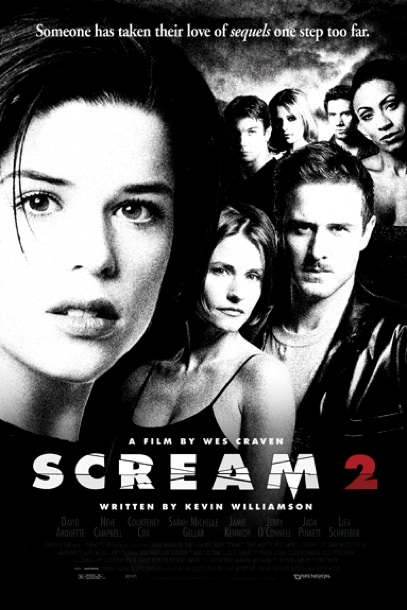
Re-watching Scream 2 for this series made me realize that it’s been a long time since I watched this or the third film. I love the first movie (duh). Clearly, I have all the time in the world for it. And I have owned the trilogy in every iteration it has appeared in (VHS? Check; DVD? Yup; Blu-ray? I bought a Blu-ray player just so I could buy and play the trilogy, ISYN). However, as time has passed, I have slowly convinced myself that the sequels are not worth watching. As the second film even addresses, very rarely do sequels prove their worth. However, the horror genre in particular seems to thrive off the existence of unchecked and often unwarranted franchises.
That being stated, are the Scream sequels terrible? No. As sequels go, they actually are quite good. In fact, this re-watching of the first sequel, again focusing on the technical merits of the film, has made me realize how strong it was on several different levels. This and the third film (we’ll get to that fourth one in a little while) also have elements of enjoyment and intrigue and, after pondering this a bit for this series, I would posit that they ultimately do add merit to the horror genre for doing to the horror franchise trope what the original did to horror in general.
First, though, I’ve been pondering why Craven was so amenable to the notion of participating in sequels for Scream when he was so adamantly against them for Freddy Krueger. I think a few things went into his decision this time. First, writer Kevin Williamson always had sequels in mind [insert predictable Stu Macher quote about sequels here]. So the option was always on the table, even when Craven first started hearing about the script, as opposed to how Craven wanted his original Nightmare on Elm Street to be a one-shot film with a definite ending. Second, I think it would be fair to surmise that Craven probably learned a valuable lesson with Freddy. If you don’t want others botching your creation, then you need to be the one driving (even if you’re driving from someone else’s map). With Scream, he realized that he could be conductor for Williamson’s death train, from start to finish, and I suspect that appealed to him, especially after the first film blew up so massively and rapidly in popularity.
And then there is the unique focus of this horror franchise. Other popular horror franchises hinged upon the killer always being the same. Not this time. No, this franchise’s focus was the exact opposite of most horror films. This time, it’s all about the survivor. Sidney is the character who doesn’t change (although let’s not forget the other survivors, two of whom stay by her side through the whole series like a Holy Survival Trinity #spoilerz). Sidney is the keystone.
[Loba Tangent: If that concept sounds familiar, it should. Craven granted the same level of power to Heather Langenkamp in his New Nightmare.]
Craven had already made a career of presenting strong female characters in many of his films. In fact, he had made a career of presenting unlikely heroes/heroines from several diverse groups, not just strong women. His last two films prior to taking on Scream, in fact, showcased casts comprising not just Black heroes/heroines, but also largely Black casts. This was practically unheard of from a serious film-making perspective at this point in the horror genre (I say serious here as opposed to horror spoofs like what the Wayans brothers were doing with their Scary Movie spoofs). Horror was a Hollywood holdout of predominantly White casts, White heroes, White villains, made for predominantly White audiences. Was that because horror is mostly preferred by White audiences? Or was it more likely because diverse audiences weren’t interested in a genre that showed no interest in them? I think Craven tested this latter theory most successfully with The People Under the Stairs, which was a genre success that very few anticipated.
[Loba Tangent: I think this was part of what made the opening sequence with Jada Pinkett and Omar Epps even more spectacular. Pinkett’s character’s lament about how the movie they were getting ready to watch was “some dumb-ass White movie about some dumb-ass White girls getting their White asses cut the fuck up” not only was a poignant castigation against several horror tropes but also made her character’s ultimate, shall we say, intrigue in the telling of that “dumb-ass” movie even more humorous.]
Therefore, a man who had spent several decades building his reputation as a Master of Horror (I think it’s time we started using that as an official title, don’t you?) through the construction of complex, complicated, and often unexpected horror heroes/heroines would naturally be drawn in by a series of movies that eschewed the traditional horror franchise route of focusing on (glorifying?) the killers for the unconventional approach of focusing on the survivor(s).
There’s also another aspect that seemed particularly prevalent and important to this sequel that I think must have attracted Craven by dint of reason that it had held such a disturbing fascination for him throughout his career: the reality of human brutality. Again, let’s think about the movies that started Craven down his path to Master of Horror status. Those movies sprang up from Craven’s desire to examine the darker sides of human nature in the most realistic ways. And now he gets this script that hinges upon examining the reality of what transpired within the first movie.
These survivors from the first movie? They’re all damaged, emotionally and in many ways physically. That “fun” first movie carried weighty consequences, which we watch play out throughout the unraveling of this and following sequels. There is still humor all throughout this sequel, but Craven and Williamson did an extraordinary job in balancing it with weightier truths for these characters, particularly Sidney. We’ll get to her in a moment, though.
First, I’d like to take a moment to talk about the opening of this film. I already mentioned that Jada Pinkett and Omar Epps bring us into the new world of Scream 2. They are heading in to a free preview of Stab, the movie based on Gale Weathers’s book on the events of the first film, The Woodsboro Murders. So basically we end up watching a movie about people watching a movie of events we’ve already watched. The continuing beauty of this is that what they are watching is both very close and incredibly far away from what actually happened in the first film. Again, Craven and Williamson are taking collective digs at the tropes of their trade in exquisite fashion. What they are also doing, and it comes through with such unsettling perfection, is juxtaposing the “reality” of horror movies for its fans against the true reality of horror.
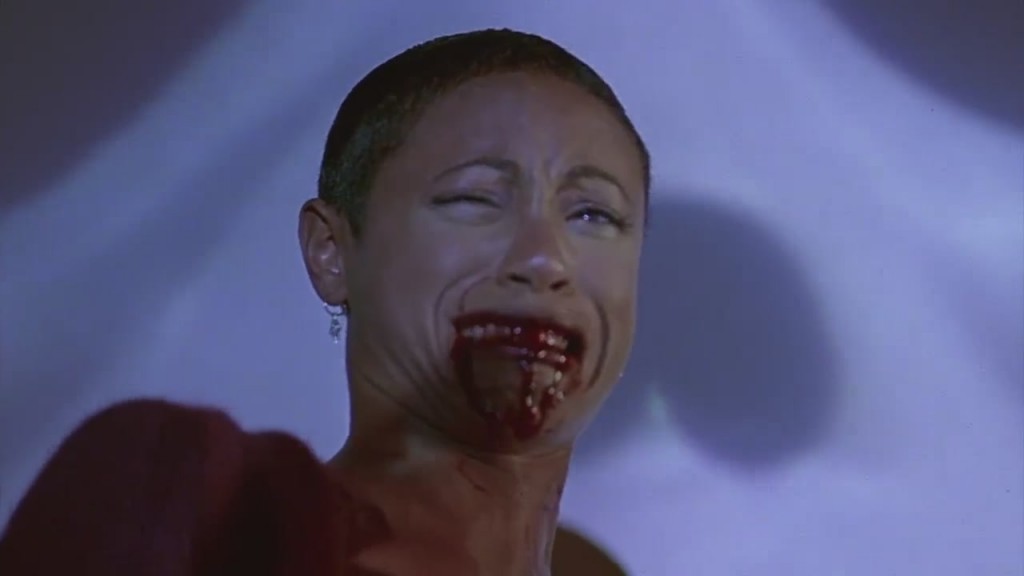
I’m referring, of course, to the murder of Pinkett’s character, Maureen Evans. I still can recall the collective silent horror shared throughout the audience I was in when we watched that murder play out. Whereas the majority of the kills in the first movie all came across in electric ways that pumped up the audience to cheer or scream or laugh or yell at the screen, this time…this time was utterly different. Craven knew precisely how to make this one of the most discomfiting deaths from the entire franchise. Whereas it was in many ways similar to the first death from the first movie, this time Craven and Williamson pulled it out of the expected solitude of a typical horror movie setup.
This was not the “girl alone in a secluded setting” predictability akin to what Heather Graham’s character was facing in the Stab film (or that Drew Barrymore’s character faced at the beginning of the first movie). This was a young woman being brutally murdered in a theater full of people. In so doing this, they not only upended the trope but they also made us uncomfortably and unwillingly that much closer to her murder. In essence, we became one with the on-screen audience, all of us watching as Maureen climbed to the front of the theater, bleeding, dying, crying out for someone, anyone to take note, take heed of what was happening. Craven had always made a point of trying to invoke a sense of moral uneasiness in his audiences, and this opening did not disappoint. I remember the disgust I felt at the opening of this film; I realize now that this was precisely the reaction I should have had.
Skipping ahead slightly in the movie but focusing on another instance in which Craven beautifully shows us how to get away with murder in a way that breaks the horror tropes apart, let’s talk about Randy. Poor Randy. All he wanted was for the geek to get the girl. Instead, he’s brutally, savagely murdered by Ghost Face in broad daylight in the middle of a crowded college quad. That was the beauty of Craven’s directorial acumen. He knew how to upend and audience. He lulled us into a sense of complacency. It’s a sunny day. People are all around. They’ve all got each other’s backs on this, right? Besides, it’s Randy! Nothing is going to happen to Randy. And then the blood began to run and we all knew, there is no understanding of sacred beneath that Ghost Face mask.
Interestingly, even the MPAA finally got on board with Craven’s focus on realism and consequences. Craven stated in interviews that he purposely made this film as bloody as he could, expecting the MPAA to come back and tell him to cut it down for an R rating as they did with the first film (and myriad other films from his career). Instead, they left the original cut of the film untouched. According to them, the violence was okay because it carried consequences. Kind of like all Craven’s other films, but never mind.
[Loba Tangent: I’ve actually not only seen the original cut of Scream but I also used to own it on VHS. It’s the version they made the director’s commentary for on that weird VHS double set I bought. I’m kicking myself that I don’t have it anymore. I’ve never seen that original cut anywhere else, not even the special edition DVD set. Craven’s original cut actually made the consequences of Billy and Stu’s actions more prevalent. The MPAA’s insisted-upon cuts took away that level of realism and left instead a false sense of invulnerability for our killers.]
And then there’s Sidney.
We watch as she starts out this round prepared, defiant. She’s armed with a caller ID and a BFF roomie and a new boyfriend and Randy (for now). She’s got this. She is ready for whatever the premiere of that stupid movie based on her chaotic life has in store. Even Tori Spelling.
[Loba Tangent: Good on ya, Tori, for having a great sense of humor and for playing along with the continuation of a line from the first film. Also, this is one of the moments from this film that falls soundly into the hilarity camp. I love how Craven is able to get the absolute worst performances from “Sidney” and “Billy” in the movie based on the first movie, thus poking fun at the original film in such a wonderful way.]
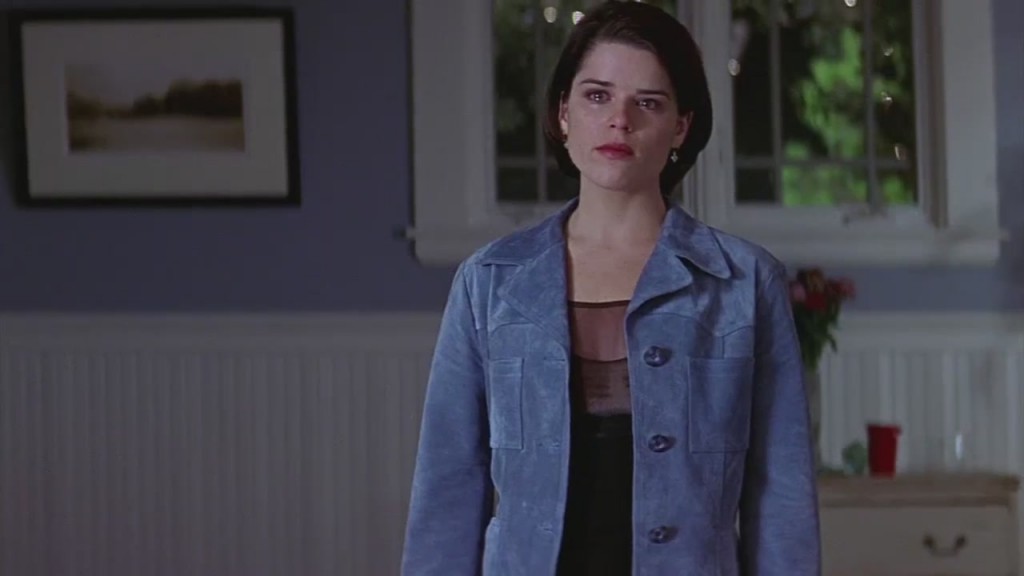
Oh, Sidney. We want so much to believe in your tough girl ruse. But Craven will not let that happen, and you know it. That moment when Sidney realizes the horror is starting again, Craven gives us this beautiful shot composition of her off-center and alone before slowly pulling in closer to her, thereby pulling us into her horror. It was so simple and yet so right.
And in case you haven’t picked up on this yet, I love Sidney Prescott. Just like Nancy Thompson, she is another one of Craven’s quintessential Warrior Women, faced with seemingly insurmountable odds but willing to dig in and find a way to survive. She refuses to lie down and accept her victimization at the hands of others wishing to make her their personal scapegoat. However, we also witness that these events harden her, to trust and to emotional stability. Her inability to place faith in anyone after her betrayal by Billy leads to the deaths of two of her closest confidantes in this film and, I believe, kills her ability to function in any publicly acceptable fashion. It actually worked out that Neve Campbell wasn’t able to be in the third movie for long, because limiting Sidney’s time in the third movie helped solidify that the damage she absorbed in this film may not have killed her, but it came pretty close to destroying her. It certainly destroyed her ability to allow herself to feel. That moment at the end when she shoots Debbie Salt/Mrs. Loomis through the forehead without even flinching? Even Cotton and Gale flinch (Gale! Flinches!), their expressions revealing their respective horror at realizing not only what Sidney has just done but also what she has just become.
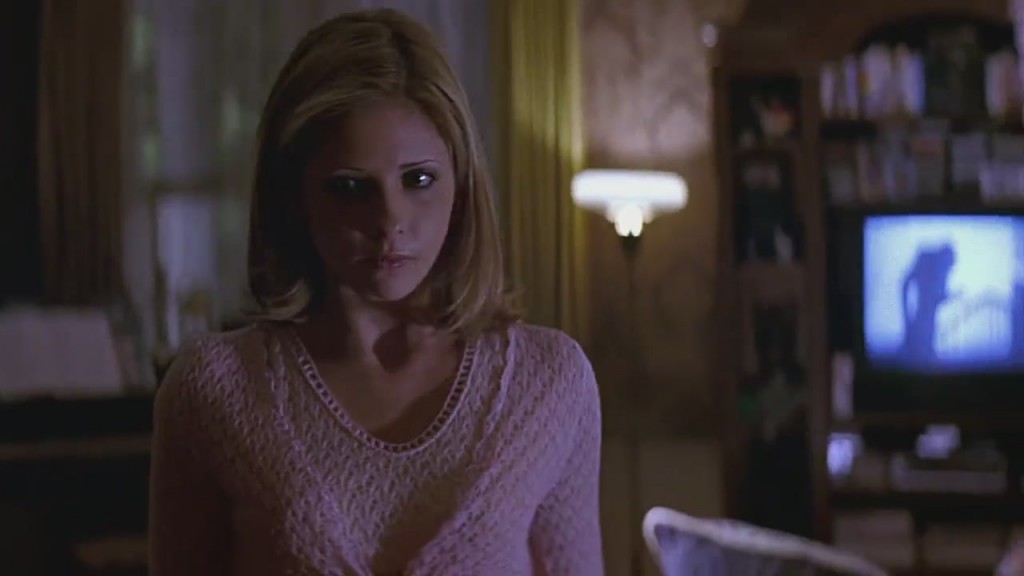
Wow, this is a long review. And I haven’t even gotten to things like the soundtrack and Marco Beltrami…or the roll call of Hollywood’s young elite who clambered to appear in this film…or the ones who were actually picked. Like Sarah Michelle Gellar. Even though she was in the middle of filming Buffy, she made time for a cameo in this film. I mention all this only for one reason: Craven’s sense of humor. See, Gellar’s scene included moments where she was watching television, and then moments where she was moving about her sorority house while the television just played in the background. Like in this moment:
Yes, denizens. That would be Nosferatu playing on the television behind Buffy the Vampire Slayer.
However, the one final thing that I would like to focus on for this film is the play scene. There is a moment in this film in which Sidney has a dress rehearsal for a play she’s in at the college. The significance of this scene from a Cravenous perspective? Craven wrote this scene and the play. The original script that Williamson wrote included some kind of generic Our Town-esque play, according to producer Marianne Maddalena. Craven, however, knew a way to write a scene that would integrate a play perfect not only for the film but also for Sidney. Let’s not forget that he was once a professor of literature or that he had a master’s degree in philosophy and writing. If anyone could come up with the perfect theme for a play suited to Sidney Prescott, it would be him.
[Loba Tangent: Also, making the play a Greek tragedy was Craven’s subtle castigation of the MPAA for their denouncement of violence of horror movies. Craven was basically pointing out that violence and horror have been a part of entertainment since the Greek tragedies. Hello, Oedipus and Medea. And yet now they are lauded as classics.]
I have to admit, the play scene is one of my favorite moments in not only the Scream trilogy but also horror in general. The way Craven not only beautifully draws the parallels between Sidney and Cassandra but also utilizes the Greek tradition of a masked chorus in such an effectively chilling way
In stark contrast to my last read that focused on life and love affirmation, I then picked up Alan Cumming’s memoir Not My Father’s Son.
Wow.
Okay, my statement isn’t completely correct. Cumming’s memoir is about life and love affirmation, with the people in his life who matter the most. However, it’s also about the brutality and manipulation leveled upon him and his brother by their father, who very clearly suffered from some form of mental illness that never received proper diagnosis or treatment. What a world of difference that might have made for everyone had that occurred.
Instead, Cumming survived as best as he could, which if you know anything about who he has become and what he has done with his life as a performer, is pretty damn well. I love Alan Cumming. Reading this book made me love him all the more.
I don’t really want to say much else about this memoir, other than that it can be a difficult read, but ultimately reveals levels of strength, solidarity, and survival within Cumming and his close circle of friends and family that are beautiful and affirming of the capabilities of the human spirit.
Final Verdict: I think this would be a worthy addition to the biographical section of my library.
I’m sure a lot of you already know that there’s a new X-Files mini-season playing right now. It’s a six-episode one-shot (so they say) that is now four episodes in. Yes, I’ve been watching it. You might have noticed that I’m a bit of a geek. And while I haven’t really geeked out a whole lot here at the lair over my two favorite FBI agents, I have mentioned them now and again. I also used them for one of my annual holiday photo manipulations.
[Loba Tangent: That might actually be one of my favorites so far…especially Scully. She looks so…right as Mrs. Claus, doesn’t she?]
So, as I’m sure you’re all wondering at this point: What do I think of the mini-season of new episodes?
Eh.
I say that with all due love and respect (to a show that I stopped watching after the sixth season and have yet to finish). Are the episodes bad? Not really. Are they great? Not really. They’re fun. And, of course, it’s great to see Scully and Mulder together again. I guess, though, that I’m growing weary of this constant nostalgia barrage from Hollywood. Just because you make something with characters that say things that will make me go “Hey, I know/remember/used to like that!” doesn’t mean that you have an automatic hit on your hands.
Of course, didn’t I just describe the whole point of The Big Bang Theory?
[Loba Tangent 2: No, seriously, didn’t I? I don’t know. I have never watched an episode of that show. After having the 10th person tell me that it was “my kind of show,” I knew I needed to stay as far away from it as possible. I’m secure that my decision was the correct one.]
Anyway, yes, I am enjoying this new season of The X-Files, if only for those purely nostalgic reasons (with some new joy thrown in here and there for good measure). I’m laughing where I’m pretty sure I should be laughing. I’m sufficiently moved by things I’m sure were engineered specifically for maximum feels. I did find the episode “Mulder and Scully Meet the Were-Monster” a bit forced. I wanted a monster-of-the-week episode. I did. I just didn’t want one that was so self-aware of being a monster-of-the-week episode. Less is more, people.
And now we’re down to the final two episodes of this mini-season. I feel as though they kind of need to get back to the whole point that they seemed to have in the first episode…and then kind of wandered away from. Not that I want a whole lot of that alien mythos BS bludgeoning me over the head. That was kind of what turned me away from the show in the first place. That and giant spider legs climbing out of someone’s mouth. That was just way more NO than I felt prepared to handle. Ever.
I’m not sure how things are going to wrap up, or even if they are going to wrap up. Maybe they’ll decide they want to do another mini-season. Or another movie. (Please don’t do another movie.) However it goes from here, I will be there to see it through. I’m happy enough revisiting these old friends that this time I’ll stick around until the final curtain call. Plus, I was promised Agent Reyes at some point before the end. I want my Agent Reyes fix, thank you.
And, of course, going home to the FBI once more has re-sparked this little PhotoShop trickery in my brain. I always wanted to do something that made Mulder and Scully’s names more than just names. Over the years, I’ve seen iterations of this idea that kind of came close but not really. This new mini-season finally pushed me to make my dreams real (dream big, Loba!). I actually pre-tested these elsewhere to what I would call success. And by success, I mean people found them to be generally disturbing. Win!
So, without further ado (or curmudgeonly rambling), I give you Agents Dana Skully and Fox Mulder. You’re welcome.
I remember reading a few years ago that Maria Bello had come out as being in a relationship with a woman. This announcement intrigued me, but then I moved on with my life, as people tend to do. I mean, it was nice reading this, and I do like her as an actress, but it was one of those things that you kind of absorb throughout the day, file away in your brain, and then quickly let it go for some other tidbit. Needless to say, I didn’t realize that she later went on to write an op-ed for the New York Times or that she then went on to write a book based on that piece.
However, during a recent library visit, that book, Whatever…Love Is Love: Questioning the Labels We Give Ourselves, was perched there on one of the shelves I was perusing, beckoning me to at least pick it up. I read the jacket blurb, read the reviews, and thumbed through the first chapter (which I now realize is pretty close to the op-ed piece that inspired Bello to write the book), and realized that I wanted to know more about what she had to say.
The book’s concept is pretty straightforward. Bello posits that we are more than the labels that either society or we give ourselves. She also posits that sometimes we give ourselves erroneous titles, either in positive or negative ways, and she proceeds to analyze some of the labels she has taken or received throughout her life. Through a series of questions, she examines what those labels mean to her and why she feels they are either deserved or unwarranted.
I was surprised to find this book quite compelling. I didn’t honestly realize that Bello had an interest in writing. I also didn’t realize that she had recently been quite ill. Thankfully, she’s better in many ways, and this book is a testament to an admirable desire on her part to better understand herself, her surroundings, her support group, and also the world in general and how her actions can help improve that world. I was fairly impressed with all that I read, and I thought it was quite sweet how her son seems to play such an integral part, not only in the writing of this book and the original op-ed but also in Bello’s desire to examine and improve upon herself.
Final Verdict: I could see this becoming a part of my library. I also would recommend it as a quick but fascinating read from an unexpected but ultimately delightful person.
I’m going to cheat slightly with this review, denizens. I recently reviewed this film elsewhere online, and rather than reinvent the wheel at this point, I’m going to use a lot of what I wrote in that “other” place, for this review. For posterity, yo.
I guess I also should finally point out that I probably will have a lot of spoilers throughout this and other Cravenous reviews. I don’t know why I never thought of mentioning this before. So, yeah. Spoilers.
So now that Wes Craven was (kind of) able to scratch that itch of wanting to direct anything other than a horror movie and found it to be less than the pleasant break he’d hoped it would be (thanks, Eddie…no, really…thank you), it was time once more to turn to what he knew and did so well. It wasn’t an instantaneous “yes” decision, mind you. It took a bit of pushing from Bob and Harvey Weinstein as well as a few of Craven’s close associates to finally convince him that it would be worth his time to take the reins on what practically everyone in Hollywood was convinced was going to be a huge horror hit. The Weinsteins were so convinced by the end of the day, in fact, that they scheduled a Christmas release for the film. A Christmas release? For a teen slasher flick? In the mid-90s?
God damn it, Gump! You’re a goddamned genius!
Seriously, though, with Craven coming on board as director, this turned out to be the “perfect storm” of a horror film. It was a brilliant script filled with admiration and adoration for a genre that, to tell the truth, had seen better days. Horror was, forgive the pun, nearly dead in the mid-90s. Fans had lost interest in tired sequels and cheesy scripts and horrible plots. It took Williamson to come along to remind us what we fell in love with and to show us that there was still life in the genre yet. His story was clever, his lines were catchy and quotable, and his characters were cliches to a point, but cliches with twists and unexpected complexities.
Combine this with a cast filled with up-and-coming young actors just starting to make an impact on Hollywood as well as a couple of established actors who were either making a successful comeback or who brought a delightful sense of nostalgia with their presence, and like I said: perfect storm.
Watching Scream again for what truly has to be beyond the 20th time I’ve seen the movie, I made a special effort to focus primarily on the look of the movie
After his success with The People Under the Stairs, it was time for Wes to come home. Time for him to reclaim his greatest creation and put the dream demon back into his proper context. And so, in 1994, Wes Craven went back to Elm Street, and he brought several members of the original cast with him. The end result?
Magic.
I’ve already written here about Wes Craven’s New Nightmare, so I don’t necessarily want to make a new post for it. However, I will reiterate that it was a brilliant return to Elm Street for Craven and a beautiful denouement to Freddy Krueger. Yes, I know that they brought him back for his battle with Jason, but I feel as though that’s an incidental addition. An appendix, if you will. This film felt like a solid conclusion to Freddy’s journey as well as Craven’s homecoming and reconciliation with Bob Shaye and New Line Cinema.
So what could possibly be next for Craven now that he had come back into his own as a “Master of Horror” and taken back his dream demon?
A comedy, of course.
Well. Kind of. A comedic horror? A horrific comedy?
Truthfully, the only thing horrifying about 1995’s Vampire in Brooklyn is how it both failed at horror and funny. Based on a story idea from Eddie Murphy and producer friend Vernon Lynch, and a script written by Murphy’s brother Charlie (along with the guys who wrote Mulan II), the movie tells the story of Maximillian, the sole-surviving Caribbean vampire, who comes to Brooklyn to find the half-vampire mate who will help him keep his line from ending.
I know what you’re thinking: Don’t vampires just make more vampires by biting someone and turning them into a vampire? That’s kind of what I thought. I also stand by my theory that vampires can’t procreate the way humans can. It’s the whole freaking point (pardon the pun) of why they have to penetrate their victims with their teeth after roofying them with their sexeh stares.
I know what else you’re thinking: Half-vampire? What the hell is that (besides Blade or Vampire Hunter D)? I’ve always questioned the idea of “half-vampire” because I question the procreation efforts of vampires. Also, it’s always sounded a bit silly to me (even though I do enjoy some of the genre stories that use such a creature). Do they only burn really badly in sunlight? Have slightly pointy teeth? Do they have a translucent reflection? Whatever it’s supposed to be, Angela Bassett plays the half-vampire, so I’m okay with letting some of those questions go.
Really, it’s Murphy who is the problem for me with this movie. I’ve never really enjoyed him as an actor. I loved his time on Saturday Night Live and I respect what he did during his stand-up days. However, most of his movie career has left me utterly cold. This movie wasn’t an exception.
Plus there is the fact that you can tell that Murphy is not really all that interested in giving a compelling performance in this role. He later stated that the only reason he agreed to this movie in the first place was because Paramount agreed to release their hold on the rights to The Nutty Professor to Murphy if he finished his contract with them. He also had the audacity to blame the wig he wore in the movie for why people didn’t like it. I totally disagree. That wig worked for Eriq La Salle in Coming to America! You just didn’t try hard enough, Eddie.
Problems compounded with the fact that Craven was excited to finally have a shot at directing a straight comedy only to find out that Murphy wanted him on board because he wanted to do something other than comedy and thought taking a crack at horror would be fun. And when your leading man is also one of the producers on a movie he came up with the story for and his brother wrote the script? There’s not a whole lot you can do besides say, “Good idea, Mr. Murphy.”
They did try to meet in the middle, and there are a lot of comedic moments to the film. We also get Murphy doing his shtick of putting on a lot of make-up and playing other characters. This time, he played a perpetually perspiring preacher and a failed Wise Guy. They were kind of funny, but also kind of stereotypical and cringe-worthy. I’ve always had a problem with a lot of the dress-up roles that Murphy did. If he were punching up with the joke, as he did on SNL, then it might be different. However, most of the time, he was only playing up stereotypes for comedic effect. That’s kind lazy comedy for no real effect other than to make fun of groups of people for assumed shared behavior. But whatever.
It was lovely getting to see Angela Bassett in this film. Craven must have appreciated her participation in his short-lived television series Nightmare Cafe (and by “short-lived,” I mean it lasted six episodes…but they featured actors from Craven’s many films, including Bassett, Brandon Adams, and Robert Englund. Oh, and Trinity, Cigarette Smoking Man, and Ishara Yar show up as well, for you genre fans). Bassett’s career at this point was starting to really pick up, with her Oscar nod securely in place for her turn (heh) as Tina Turner and Strange Days helping to secure her as a player in the genre fiction realm.
[Loba Tangent: Sad trivia, really. Sonja Davis, the stunt woman who doubled Bassett on Strange Days, followed her to this film only to die during a failed stunt that put her in a coma for almost 2 weeks before she passed.]
Her performance as Detective Rita Veder in this film was absolutely one of the standouts. She clearly was willing to embrace the ludicrous lunacy of the story and her role, and she played every moment with a refreshing dedication that I’m sure pleased Craven, particularly on this film. Other than Bassett, I’d have to say that Kadeem Hardison was probably the best part of this movie. Playing Julius Jones, the Maximillian equivalent of Dracula’s Renfield, Hardison brought a zeal to his role that was (sadly) unmatched by his main foil. Also, he did quite well in a role that was both a throwback to and departure from his most iconic role, Dwayne Wayne.
Remember, I did say that when an actor impressed Craven, he made sure to be loyal to that actor. Just ask W. Earl Brown, who appeared in this film and may or may not appear later on in this blog series. Isn’t that right, Kenny? Now get off my windshield.
Even though it wasn’t the complete break from horror that Craven had longed for, this still was probably the first of his films to integrate other-than-horror elements into the story blatantly (rather than subtly, as Craven had often tried to do with other films) without getting blow-back from producers or the movie company in charge. Of course, the movie didn’t even make back what it cost to make it, so I’m sure that wasn’t the resounding success that Craven had hoped for with his first non-horror horror movie.
Guess there was really only one way to go at this point. Back to horror…
Deprecated: Function get_settings is deprecated since version 2.1.0! Use get_option() instead. in /home/ih1v0f0zxragxwcy/public_html/blog09/wp-includes/functions.php on line 6078
Deprecated: Function get_settings is deprecated since version 2.1.0! Use get_option() instead. in /home/ih1v0f0zxragxwcy/public_html/blog09/wp-includes/functions.php on line 6078